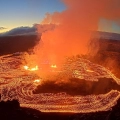
This live camera is located at the University of Alaska Fairbanks Robert G. White Large Animal Research Station and faces the northern sky. In Interior Alaska the aurora can be very active from fall through early spring, usually in the late night to early morning hours, and is visible when skies are clear. The aurora is a light seen around the Earth's magnetic poles: charged particles streaming from the Sun in the solar wind enter the atmosphere, collide with oxygen and nitrogen atoms and release energy as light, much like a neon sign. The result is curtains and waves of green light, sometimes with pink and violet hues, dancing across the sky. By day and on cloudy nights the camera shows the landscape and sky over Fairbanks. Alaska is four hours behind Eastern Time. A stream from the explore.org network, in partnership with the University of Alaska Fairbanks.
 United States - Fairbanks - AK


































 Canada - Hanson Island - BC


 Japan - Tokyo
 Israel - Jerusalém